
Micro Data Centers in Your Backyard: Who Really Pays the Cost?
Across the country cities, counties, regulators, and utilities are examining rate impacts of large, centralized data center loads. There have been development moratoriums in some places, and, in others, strict legislation that requires a separate rate schedule for data center loads. All these strategies are aimed at ensuring the cost of serving large data center loads are not borne by existing ratepayers. Then came an idea by NVIDIA that could bypass these ratepayer protections.
NVIDIA has proposed a micro data center model where AI data centers are distributed to your literal back yard. The idea is simple: add modular AI units with battery storage to your home and get paid $500 per month for the use of your electric and network services. Participants are compensated regularly plus have the ability to use the on-site battery during power shut offs. For those located in very warm climates, this is undoubtedly appealing. From the business side, distributed data center deployment is expected to be faster than the large, centralized data center construction and cost significantly less.
Imagine AI companies working with developers to install these modular units in new housing developments. It would result in immediate AI capacity without the hassle of public review or the need for companies to provide public services such as water supply project funding or long-term local job creation. This article doesn’t address these issues, nor does it contemplate the home security, noise, and privacy impacts. We also don’t talk about the impact on your early evening streaming experience. Rather, we wanted to know how residential rates could be impacted. Specifically, does the benefit of adding data center load to residential usage profiles outweigh the cost of the load addition?
To find out, we first need to understand how a 200-amp panel can meet energy demands of a modular data center. A typical 200-amp panel can handle 38 kW of demand, however, engineers will load a panel up to 80% of its rated capacity. This means that a 200-amp panel should be loaded only up to 30.4 kW. Average residential home demand is often much less than this maximum. NVIDIA estimates that residential demand uses only 40% of panel capacity. We find that this estimate is roughly correct. Maximum residential demand will vary significantly be region (i.e. heating and cooling loads), and other electric equipment used in the home. In homes with high heating and cooling loads 15-20 kW maximum demand is not uncommon. Therefore, in many cases, adding a 10 kW data center to a 200-amp panel is technically feasible.[1]
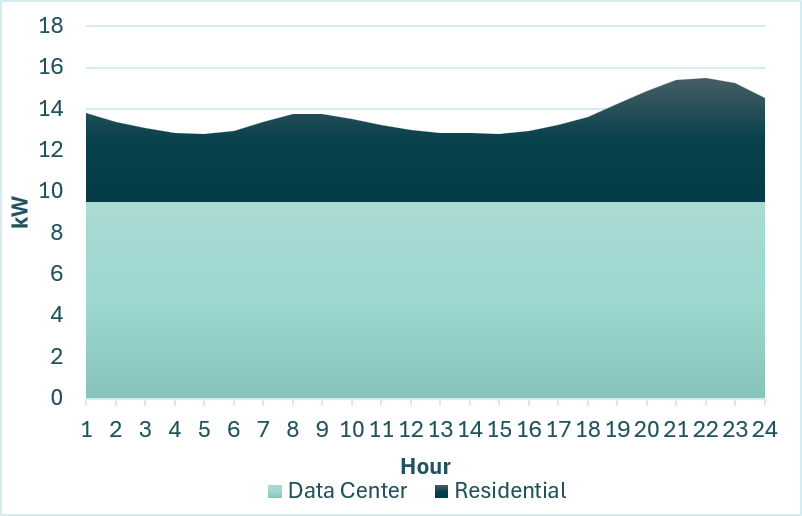 Data centers are famously associated with high load factors[2] often exceeding 90%. High load factors mean high utilization of installed capacity. In ratemaking, classes with higher load factors are generally lower average cost to serve from a power supply and delivery perspective. Essentially a micro data center would add a flat block of demand to the typical residential load profile with a morning and afternoon peak (see figure). If we add enough base load to a residential class, the class load factor increases. All else equal (all else is never equal), the average cost to serve residential customers will decline.
There are, however, many problems with this unused capacity argument made by NVIDIA. The first is that the distribution system was not designed to serve residential customers with a large base load data center hanging out by the trash bins. On paper, the residential class load profile becomes “better.” However, widespread micro data center adoption will increase transformer and substation loading and require accelerated system capacity upgrade needs. This equipment is sized according to load diversity assumptions across the various usage types on the system. Adding baseload throughout increases coincident peak demand and reduces load diversity. This is very different from beneficial electrification where electric vehicle charging can fill in the valleys of a residential load profile.
To help us understand the system impact of increased coincident peak demand, we consider capacity charges. System capacity charges[3] can be administered by utilities, to new customers or existing customers requesting service upgrades, when the service is installed. The charge helps protect existing customers from the higher cost of the expanded distribution system caused by serving the increased load.[4] Essentially, the customer pays to “buy-into” the existing system. Capacity charges increase the intergenerational equity between ratepayers by balancing the cost responsibility of the distribution system assets between existing and new customers. These charges often range between $20 and $60 per kVa. An aggregate total of 10 MW in micro data center use behind a residential meter would avoid paying its fair share of system capacity costs valued between $250,000 and $750,000.[5] This is achieved by 1,000 customers participating in a program and the range of capacity costs stated above. If we amp participation up to 10,000 customers, we are now in the $2-$8 million range in system impacts.
The second problem is that increased demand for electricity increases reliance on electricity supply procured at high marginal costs. Utility embedded power supply costs are usually much lower than marginal costs especially regarding capacity. If we are fair cost of service analysts, we would allocate the cost of marginal resources to rate classes with growth. The average embedded cost for public utilities in the Pacific Northwest averages $45-$60/MWh for power supply and transmission. Marginal costs are forecast to be approximately twice this level. Similar to the effects of distribution costs, if new customers are not charged for the higher, marginal costs of generation expansion, existing customers will pay more for increased costs of power supply.
Third, the choice might be either-or for many residential consumers. With a micro data center using excess capacity, service upgrades would be required before additional electric equipment can be installed such as an EV charger, pool heater, or heated helicopter pads. Hey NVIDIA, have you tried offering data center-heated hot tubs?
To explore the rate impacts, the first 2 issues are modeled. Starting with a standard public utility residential rate class, we add different levels of micro data center penetration to the system. Our hypothetical utility has 40,000 residential customers and 1,000 non-residential with a peak demand of 300 MW, before micro data centers are added. Incremental power supply costs are directly assigned to the residential class. Embedded power and transmission purchases average $58/MWh while the assumed marginal cost is $100/MWh. The table below shows us the net impact of better load factors but higher energy costs.[6]
Residential Bill Impact with Micro Data Centers on System
| Status Quo | 10 MW Micro Data Centers |
100 MW Micro Data Centers |
|
| Fixed Charge,$/Mo | $36 | $36 | $36 |
| Energy Charge, $/kWh | $0.0925 | $0.0951 | $0.1061 |
| Bill at 1,500 kWh/month | $175 | $179 | $195 |
| Bill Impact | 2.2% | 9.3% |
The above impacts would be in addition to rate impacts from distribution capacity investments if a utility does not also have an appropriate capacity fee.
The analysis shows that the sales pitch for micro data centers is rosy at best. If disaggregated data centers become the next best thing, utility regulators might be tasked with defining greater rules around residential service. Rules should define what type of end-use qualifies as residential and if certain end-uses disqualify customers for low income or other discounts. In the past, residential rate classes have benefited from their class designation. From rural electrification to ratepayer protections, the residential class holds certain sanctity among public power. Disruptions to this designation may be unwelcome from consumers and utility regulating boards alike.
This article was not written by AI.
Amber Gschwend
Director, GDS Consultants
[1] NVIDIA does not disclose the proposed size of modular data centers.
[2] Load factor is the ratio of average demand to maximum demand
[3] The name for these charges varies by utility including Capacity Charges, Backbone Mitigation Fee, or System Development Charges, or System Impact Fees.
[4] Or the cost of new system expansion to meet growth.
[5] Assumes micro data centers are installed on homes that would not require service upgrade.
[6] Not included: increased operating costs due to customer service questions, service upgrade costs, distribution system upgrades.