
The Grid Is Changing Faster Than Ever
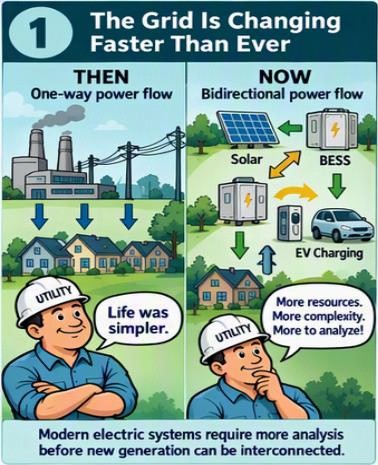
The accelerating deployment of distributed energy resources (DERs), including photovoltaic (PV) generation and battery energy storage systems (BESS), is fundamentally changing how electric distribution systems operate. Historically, distribution networks were designed around predictable, one-way power flow from centralized generation sources to customer loads. Today’s grid must accommodate bidirectional power flow, inverter-based generation, and increasingly dynamic operating conditions.
As a result, DER effects to the grid should be studied in the Interconnection Impact Studies which have become one of the most important engineering tools available to electric utilities. Far more than a procedural requirement, it serves as a comprehensive technical evaluation that determines whether a proposed generating facility can operate safely and reliably alongside existing utility infrastructure while complying with applicable industry standards and utility operating practices.
Understanding why these studies are necessary begins with understanding what they actually evaluate.
Interconnection Capacity Is About More Than Feeder Loading
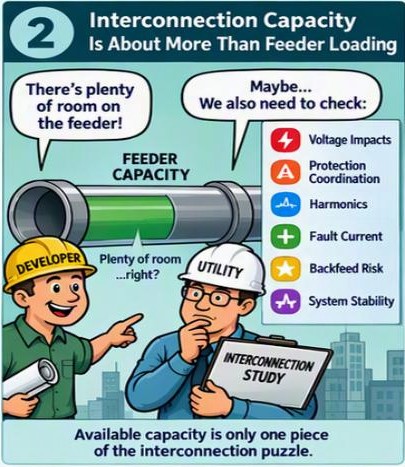
One of the most common misconceptions surrounding distributed generation interconnections is that available thermal capacity alone determines whether a project can be accommodated. In reality, a feeder that appears to have ample capacity may still experience operational concerns once generation is added.
A properly conducted Interconnection Impact Study evaluates how a proposed resource interacts with the electrical system under different operating conditions. Engineers examine steady-state load flow performance, feeder voltage profiles, voltage regulator operations, fault contributions, abnormal system parameters, return-to-service behavior, unintentional islanding, harmonics, and potential impacts to existing protection schemes.
The goal is not to identify reasons to reject a project. Rather, it is to identify potential concerns early enough that practical engineering solutions can be implemented before construction begins. Among those concerns, protection coordination is often one of the most critical.
Protection Coordination: Maintaining Safe and Reliable Operations
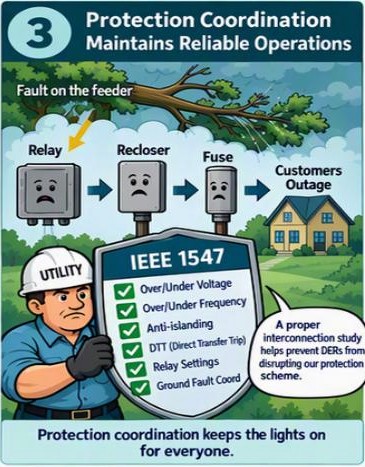
Protection systems installed throughout a distribution network are designed to detect and isolate faults quickly while minimizing customer outages. The addition of distributed generation can alter fault current magnitude, change fault current direction, and affect the operation of relays, reclosers, and fuses that were originally designed for a radial system.
Consequently, utility engineers must verify that a proposed generating facility complies with the protection requirements established by IEEE 1547 and utility-specific interconnection standards.. The review evaluates the DER’s required response to abnormal voltage and frequency conditions, including applicable ride-through and trip settings, unintentional-islanding performance, reclosing coordination, and coordination with utility protection systems.
Particular attention is given to the facility’s ability to rapidly disconnect during abnormal system conditions. In situations where there is a possibility that a DER could unintentionally sustain an electrical island after separation from the utility source, the study may recommend a Direct Transfer Trip (DTT) scheme. These communication-assisted protection systems ensure prompt generator disconnection and are widely recognized as an effective means of reducing islanding risk.
While protection requirements ensure a DER responds appropriately to abnormal conditions, utilities must also confirm the resource can safely parallel with the system during normal operation.
Synchronization Requirements Protect Both the Grid and the DER
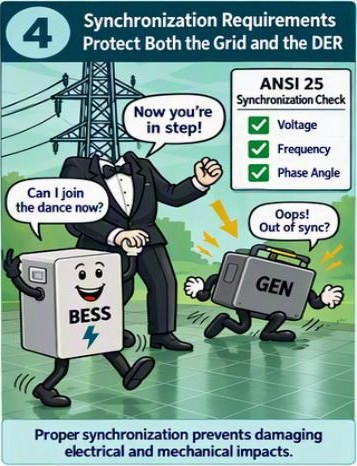
Before any generator can be connected in parallel with the electric system, voltage magnitude, frequency, and phase angle must be sufficiently aligned with the utility source. Improper synchronization can produce significant electrical and mechanical stresses, resulting in excessive currents, voltage disturbances, nuisance protection operations, or even equipment damage.
For this reason, utilities commonly require compliance with synchronism-check requirements associated with ANSI Device 25 as well as the performance requirements outlined in IEEE 1547. Although modern inverter-based resources perform synchronization automatically through advanced control systems, utility engineers must still verify that these controls will function properly under all expected system conditions.
Interconnection studies also examine how the facility behaves following system disturbances. A setting is used to delay return-to-service from 0 to 600 seconds, following the loss of utility source. This delay helps prevent large numbers of distributed resources from reconnecting simultaneously while voltage and frequency conditions are still stabilizing, thereby supporting orderly system restoration.
Once synchronization and operational behavior have been evaluated, the next step is assessing how the resource will affect system fault levels.
Understanding Fault Current Impacts
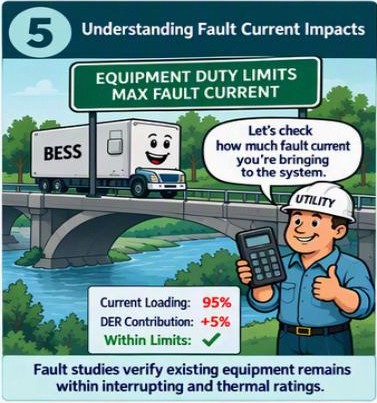
Fault current analysis remains a fundamental component of every Interconnection Impact Study. Although inverter-based resources generally contribute less fault current than traditional reciprocating generators, their contribution can still influence protection system performance and equipment duties.
Engineers evaluate both maximum and minimum fault scenarios to verify that breakers, reclosers, conductors, transformers, and other utility equipment remain within their established ratings. These studies help determine whether existing protection settings remain appropriate and whether any equipment limitations could be exceeded under future system conditions.
In many cases, the analysis demonstrates that fault current increases are relatively modest and that existing utility infrastructure can continue operating safely without modification. When concerns are identified, however, the study provides the technical basis necessary to develop targeted mitigation measures.
Beyond fault performance, utilities must also ensure the project complies with the standards that govern DER operation.
Industry Standards Provide the Technical Foundation
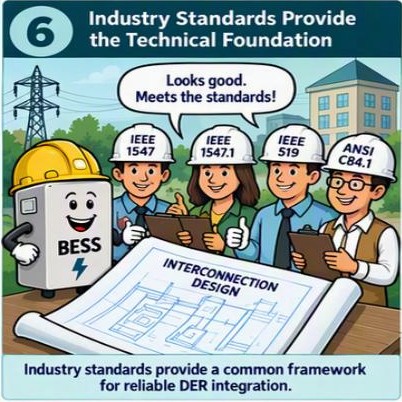
Compliance with established industry standards is woven throughout the entire interconnection review process. Standards such as IEEE 1547, IEEE 1547.1, IEEE 519, and ANSI C84.1 establish the technical framework governing DER performance, interoperability, power quality, voltage regulation, and testing requirements.
Interconnection Impact Studies help utilities verify that proposed facilities will operate consistently with these standards while integrating seamlessly into the broader electric system. This standardized approach helps create predictable operational behavior and ensures that new resources support, rather than compromise, system reliability.
However, the true value of an Interconnection Impact Study is not simply validating compliance.
Turning Uncertainty Into Actionable Engineering Solutions
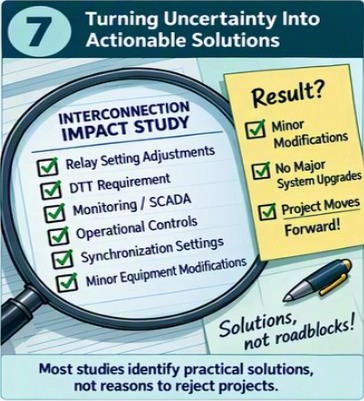
Perhaps the greatest benefit of an Interconnection Impact Study is its ability to transform uncertainty into actionable engineering decisions. Contrary to popular perception, the outcome of a study is rarely a project denial.
More commonly, the analysis identifies relatively minor modifications that allow the project to proceed safely. These improvements may involve protection setting adjustments, communication systems such as Direct Transfer Trip, monitoring requirements, operational controls, synchronization settings, or other engineering refinements.
By identifying these requirements early in the development process, utilities and developers can avoid costly redesigns, reduce schedule risk, and improve the overall efficiency of project execution.
Ultimately, this proactive approach benefits both utilities and project developers while supporting broader grid modernization objectives.
Supporting a Reliable and Modern Electric Grid
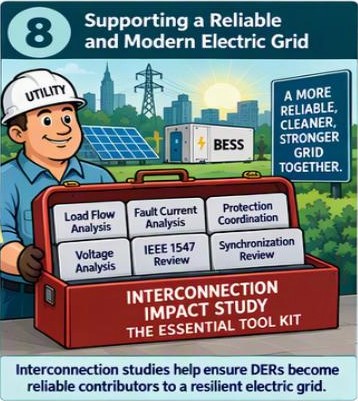
As distributed generation and energy storage continue to expand across North America, Interconnection Impact Studies will remain essential to balancing innovation with reliability. These studies provide utilities with confidence that new resources can be safely integrated, help developers understand technical requirements before construction begins, and support informed engineering decisions throughout the project lifecycle.
Rather than serving as barriers to renewable energy development, Interconnection Impact Studies are valuable planning tools that help ensure distributed resources become reliable contributors to a resilient, efficient, and increasingly complex electric power system. Through careful evaluation of protection systems, synchronization requirements, fault current impacts, voltage performance, and compliance with industry standards, utilities can successfully integrate new generation while maintaining the reliability their customers depend upon.