
2-Sentence Summary:
- FERC found PJM’s Tariff and business practices regarding Co-Location and Behind the Meter Generation (BTMG) to be unjust & unreasonable.
- New transmission service types allow for flexibility for Co-Located facilities, with details to be determined in a paper hearing process.
Interconnecting large loads on the transmission system (such as data centers) and Co-Located Facilities are two of the hottest energy regulatory topics thus far in 2026.
On December 18th, 2025, the Federal Energy Regulatory Commission (FERC) issued an Order on a show cause proceeding regarding PJM’s handling of Co-Located Resources. This Order applies to PJM specifically; however, this framework may be precedent-setting and could be applied to other regions in the future.
FERC’s Order on PJM Co-Location ruled on the following:
- PJM’s Tariff is unjust and unreasonable because it does not contain provisions of service applicable to:
-
- Interconnection Customers who can serve load from their own local generation, and,
- Eligible Customers[1] taking transmission service on behalf of their own Co-Located Load.
2. PJM’s Tariff is unjust and unreasonable because it does not account for a situation in which an Eligible Customer taking service on behalf of a Co-Located Load is willing and able to limit its withdrawals under certain conditions from the transmission system.
3. PJM’s Behind the Meter Generation (BTMG) rules are unjust and unreasonable because loads with BTMG are not fully accounted for in resource adequacy planning and shift costs onto other transmission customers, which is contrary to FERC’s cost causation principles. The Order discusses BTMG rules further; however, BTMG is not the primary focus of this communication.
4. FERC directs PJM to create three new types of transmission service, for when an Eligible Customer takes transmission service on behalf of the Co-Located Load:
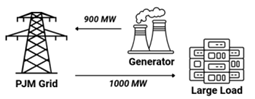
a. Traditional “Front-of-Meter” Firm Network Integration Transmission Service (NITS) remains unchanged. PJM will continue to plan all transmission and generation to serve load, even during peak conditions.
 \
\
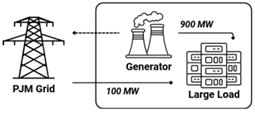
b. Firm Contract Demand Transmission Service will allow Co-Located Load to reserve and pay for a certain amount of transmission service from the grid and receive the rest of its capacity needs from its Co-Located Generator. PJM has no obligation to serve the Co-Located Load above the reserved amount. In the example illustrated below, the Co-Located Generation produces 900MW for the Load, and Load pays for 100MW of firm transmission service. Here, PJM has no obligation to serve above 100MW.
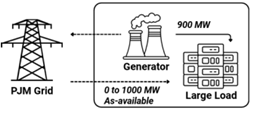
c. Non-Firm Contract Demand Transmission Service will allow for Co-Located Load to pay for transmission service on an as-needed basis, and PJM would have no obligation to serve the load if no capacity was available. In this example, again, all or a portion of the Co-Located Generator is devoted to the Co-Located Load.
d. Interim Non-Firm NITS Transmission Service will be available until all Network Upgrades necessary to provide NITS transmission service are complete. In this example, the Co-Located Load & Generation receive Non-Firm Transmission Service as soon as practicable and convert to traditional NITS Firm Transmission Service when all necessary network upgrades are in-service. Here, the Co-Located Generator can serve Load when the grid is either unavailable or when waiting to connect to the grid.
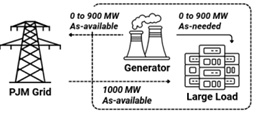
The fundamental feature of the new Contract Demand transmission services allows a Co-Located Customer serving Load to limit withdrawals from the system and potentially insulate themselves from triggering unnecessary and costly network upgrades. Regardless of choice of transmission service, the Order clearly states that Co-Located Loads must pay for ancillary services on a gross demand basis to ensure cost recovery of the provided ancillary services.
Prior to this proceeding, PJM issued guidelines[1] regarding Co-Located Load in 2024; however, these provisions were never memorialized in the Tariff. This proceeding originated from a Section 206 complaint filed by Constellation Energy (Docket EL25-20). In the complaint, Constellation included claims of discrimination regarding these guidelines, stating that due to Tariff ambiguity, Transmission Owners have been stonewalling Co-Location to stifle competition of generation resources to serve large loads. FERC granted in part and denied in part Constellation’s complaint against PJM.
As far as next steps, FERC established a paper hearing process to determine just & reasonable rates, and terms & conditions for the new transmission service types. The paper hearing questions address several topics, including rate design & cost allocation, minimum charges for grid connectivity, penalty rates, reliability and operational requirements, and curtailment protocols. PJM’s initial brief on these matters is due 2/16/2026.
Our industry faces new and complex challenges in accommodating the rapid growth of large loads and Co‑Located Facilities across the country. While this Order applies to PJM today, the transmission service implications and the underlying issues it addresses extend beyond PJM. With the introduction of new transmission service types tailored to customers with Co-Located Facilities who can limit withdrawals, this new benchmark for flexibility allows the grid to support rising demand. These reforms signal a shift to swiftly connecting large loads, decreasing network upgrade costs, and customers to better manage their facilities. FERC’s approach in PJM may serve as a framework for future transmission service and Co-Location reforms elsewhere.
[1] PJM’s Tariff defines an Eligible Customer as: (1) any electric utility or any person generating electric energy for sale for resale, but with respect to transmission service that FERC is prohibited from ordering by FPA section 212(h), such entity is eligible only if the service is provided pursuant to a state requirement that the Transmission Provider or Transmission Owner offer the unbundled transmission service, or pursuant to a voluntary offer of such service by a Transmission Owner or (2) any retail customer taking unbundled transmission service pursuant to a state requirement that the Transmission Provider or a Transmission Owner offer the transmission service, or pursuant to a voluntary offer of such service by a Transmission Owner. PJM, Intra-PJM Tariffs, OATT, § I.1 Definitions – E-F (41.0.0). An Eligible Customer may include, but is not limited to, electric utilities and power marketers
[2] AD24-11 ORDER ON SHOW CAUSE PROCEEDING, DIRECTING COMPLIANCE FILINGS, ESTABLISHING PAPER HEARING, AND GRANTING IN PART AND DENYING IN PART COMPLAINT
[3] https://www.pjm.com/-/media/DotCom/markets-ops/rpm/rpm-auction-info/pjm-guidance-on-co-located-load.ashx